Inside the Economy in Cricket: The Money Chain Behind Every Match
Cricket as a multi-layered economy
Cricket’s popularity creates value far beyond the stadium gates. A packed ground in Dhaka or Chattogram is only the most visible part of a much larger commercial structure.
Our previous article looked at the match-day fan: the tea stall owner, the street vendor and the small shop that sells more on a big night. This piece zooms out. It follows the money upward, from the jersey on a fan’s back to the multi-million sponsorship cricket contract on the front of a team shirt.
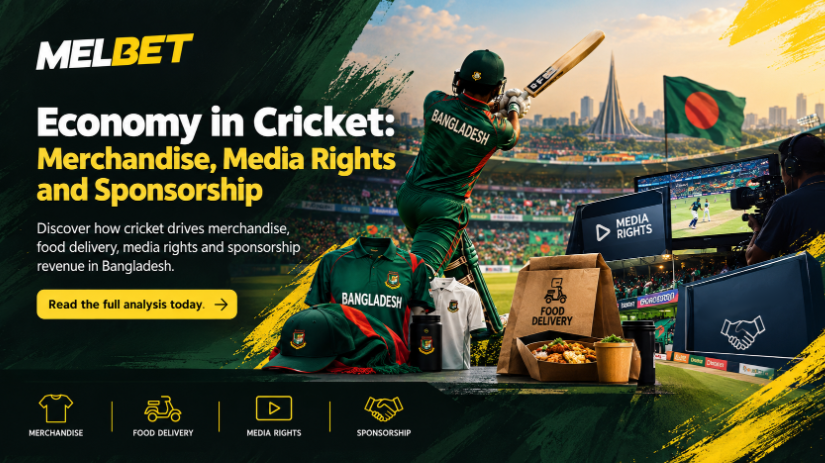
The chain has four main links: merchandise, food delivery and hospitality, media rights, cricket advertising and sponsorship. Each feeds the next. Fan passion sells shirts and drives late-night orders. That passion also builds the audiences broadcasters pay for and the reach brands want to buy. The money then flows back into the game through boards, leagues and franchises.
Understanding this chain matters for several groups:
- Fans: they see why their attention is so valuable.
- Local businesses: they can spot where to plug in.
- Administrators: the Bangladesh Cricket Board and its regional peers can plan investment and grow the sport’s commercial base deliberately instead of by accident.
Merchandise: the shirt as a status symbol
Walk through any market before a major tournament and the signs are clear. Jerseys, caps, flags, face paint, scarves and replica kits appear on stalls almost overnight. Demand follows the calendar. It spikes around a World Cup, an Asia Cup or the start of a cricket league season, then settles until the next event.
The merchandise market has two layers.
The official layer covers licensed kits and fan products sold through boards, franchises and authorised retailers. It produces clean revenue: licensing fees, royalties, taxes and formal employment. It also gives rights holders a direct line to fans and a way to measure demand.
The informal layer is larger in many South Asian markets. Local printers, tailors, screen-print workshops and street sellers turn out affordable copies and fan-made accessories within days of a squad announcement. This is not always licensed, but it supports livelihoods. A single workshop may employ a handful of people, and each of them supports a household.
Bangladesh has a particular advantage here. Its garment industry is among the world’s best-known, so the skills, machinery and supply chains for fast-turnaround apparel already exist. A well-managed licensing system could channel some of that capacity into official fan wear. Local manufacturers would benefit, and so would the board.
Merchandise also does more than earn money. A fan in a national jersey is advertising the team, the sponsor on the chest and the tournament itself.
Deliveries and match-day consumption
Match nights also reshape how people eat, and that shows up in delivery data. Food delivery platforms and restaurants see orders surge as an innings starts and again in the break. For day-night fixtures, and for events played in different time zones, demand extends into late-night and early-morning hours when most kitchens would normally be quiet.
Consumption now takes several forms:
- Family-size meal bundles ordered for watch parties.
- Restaurant “match-day packages” bundled with big-screen viewing.
- Snacks, soft drinks and groceries delivered during key overs.
- Late-night orders during overseas tournaments.
This links directly back to the local-business theme of the last article. Neighbourhood eateries and tea stalls still gain from crowds gathering to watch. But platforms and larger chains capture value too, through commissions, delivery fees, advertising slots and data about when and what fans order.
Cloud kitchens are a good example. They have no dining room, only a kitchen and a delivery radius. They can design menus around a tournament, launch limited-edition “final night” combos within hours and scale staffing up and down with the fixture list. The lift is temporary, but it is significant. It also reaches riders, packaging suppliers, payment providers and logistics firms.
The same habits show up online. Bengali-speaking fans increasingly look for content in their own language, from match previews to product and service write-ups, and a query like MelBet review (মেলবেট রিভিউ) is one example of how that local-language search culture reaches into the wider fan economy.
Media rights: the value of the broadcast window
If merchandise and deliveries are the grassroots of the economy, media rights are its financial backbone. Television and digital rights are usually the largest single revenue stream for a cricket board or league. Broadcasters pay for exclusive access to the live action because it reliably delivers audiences, and audiences can be sold to advertisers.
India shows the scale. For the 2023–27 cycle, the IPL’s media rights sold for Rs 48,390 crore, or about US$6.2 billion at the time, in a deal that placed the league among the world’s most valuable sports properties by per-match value. Disney Star holds the domestic television rights in a deal worth about US$3.02 billion, and Viacom18 holds the streaming rights for about US$3.05 billion. That total is more than double the previous agreement. Streaming viewership is now greater than the linear broadcast audience, helped by free mobile access.
For a closer look at how a single league can move a national economy, see our earlier analysis of how the IPL became India’s economic driver and how the Pakistan Super League is transforming the country’s economy.
The shift to streaming changes the whole ecosystem. Fans watch on phones, in short clips and through second-screen apps instead of one living-room television. That opens new advertising inventory, such as in-stream ads, sponsored replays and interactive features. It also creates jobs in production, commentary, graphics, analytics, social media and content marketing. The phone-first habit even shapes what fans type into search bars, with terms such as MelBet mobi reflecting how many people now expect every service, from scores to sports platforms, to work in a mobile version.
New markets are also opening up. Major League Cricket in the United States is one example of a cricket league built from the start for a streaming-era audience, with a new fan base and new commercial partners. The economy in cricket is no longer concentrated in a few Asian strongholds.
For Bangladesh, the lesson is clear even though the numbers are smaller. Domestic broadcast deals for the BPL and home series, together with digital viewership of international events, are a growing source of revenue and exposure. A strong broadcast package does more than pay the board. It builds the audience that makes sponsors pay more, and it gives local talent, from commentators to camera crews, a career path.
Sponsorship: brands buy belonging
The fourth layer is sponsorship, and it is where emotion and money meet most directly. Cricket offers brands several kinds of partnership:
- Title sponsors attach their name to a tournament or series.
- Team sponsors appear on kits and branding.
- Official partners hold category rights, such as official beverage or payments partner.
- Product placement and on-ground branding put a logo in front of the camera.
- Digital campaigns extend a partnership into social media, short video and fan competitions.
Brands invest heavily for three reasons. The first is reach, because cricket delivers enormous, repeated audiences across South Asia and the diaspora. The second is emotional connection, because fans form lasting loyalty to teams and players, and that loyalty can transfer to a cricket sponsor. The third is demographic targeting, because cricket draws young, mobile-first audiences that many advertisers want.
MelBet’s footprint in sport
MelBet is one brand that has built its presence through sport. It describes its approach with a simple core idea, “your bro”, which is a friendly, approachable tone aimed at fans. Its partnerships span several sports:
- Cricket: principal sponsor of the Saint Lucia Kings, the CPL champions, and a partner of the Trinbago Knight Riders.
- Football: collaborations and regional partnerships with clubs such as Juventus FC, Yangon United FC and Chennaiyin.
- Kabaddi: sponsor of the Jaipur Pink Panthers in India’s Pro Kabaddi League.
The brand has also worked with a range of ambassadors over time. These include football legend Didier Drogba, cricket star Faf du Plessis, former footballer Mohamed Zidan. Its current ambassador is Dwayne Bravo, the former West Indies captain and two-time T20 World Champion, who signed with MelBet Partners & Affiliates in April 2026.
The pattern is typical of modern sports marketing. A brand picks properties with passionate followings, pairs them with recognisable faces and keeps showing up across seasons.
High visibility also invites scrutiny, as it does for any large consumer brand. Fans who want a balanced view often compare official announcements with independent feedback, and searches for MelBet complaints are part of that due-diligence habit.
Sponsorship money matters to the game as well. It helps cover player pay, academy programmes, grounds and travel, and it lets leagues keep ticket prices lower than they otherwise would be.
How the pieces fit together
These four streams are not separate. They reinforce one another.
A thrilling series fills grounds, sells shirts and drives delivery orders. The same series lifts viewership, which raises the value of the next media rights deal. Higher viewership also raises what sponsors will pay for a logo or a campaign. Sponsor and broadcast money then flows back to boards and franchises, who spend it on talent, facilities and marketing. Better cricket attracts more fans, and the loop continues.
Every turn of the loop also creates work outside the sport itself: printers, riders, camera operators, designers, social media managers, caterers and event staff.
Opportunities for Bangladesh
Several openings stand out for Bangladesh’s cricket ecosystem and the businesses around it:
- Licensing and local manufacturing: a clearer official merchandise system could use existing garment capacity and bring informal sellers into a formal market.
- Better data on match-day demand: boards, platforms and retailers can coordinate promotions and logistics around fixtures.
- Stronger digital packages: well-priced streaming deals can widen the audience and open new advertising formats.
- Sponsor-ready properties: professional presentation, consistent scheduling and good audience data make leagues easier for brands to back.
- Cricket tourism: visiting supporters need hotels, transport and food, which links match days to the wider hospitality sector.
Trends to watch
Several trends are already visible:
- Digital rights: more matches are moving to streaming, with bundles tailored to mobile users.
- Data-driven sponsorship: brands increasingly want proof of results, such as viewing time, engagement and sales lift.
- Cricket tourism: fans travel for marquee tournaments, adding to local spending.
- Personalised fan experiences: apps, loyalty schemes and second-screen content bring fans closer to the action.
Fan connection in the bigger picture
Fans sit at the centre of all of this. They buy the shirt, order the food, watch the broadcast and respond to the sponsor’s message. The commercial ecosystem exists because they care.
Today’s fans also engage in more ways than before. They track live scores on their phones, check the cricket score board between overs, read form guides, debate selections on social media and watch highlights on demand. Some go a step further and place bets on sports betting platforms such as MelBet, which offer extensive cricket coverage alongside other sports. This is a natural observation about contemporary fan behaviour. Wherever there is a passionate audience and a digital device, a new layer of engagement tends to appear.
Naturally, security matters, and the most common question readers in this market ask is «Is MelBet legal in Bangladesh?» Yes, the platform operates legitimately under an international gaming licence, providing a secure and regulated service for fans across South Asia. For an overview of how the platform is regulated across the region, see this MelBet review. Betting should always be legal where the user lives, limited to adults and treated as entertainment, with firm personal limits.
Looking ahead
Economy in cricket is more than the sum of its parts. For Bangladesh, the outlook is encouraging. The game has passionate audiences, a young population, a strong manufacturing base and growing digital habits. If boards, businesses and brands work from the same picture, each match can create more value for the game, for local entrepreneurs and for the fans who make it matter.