
The Tigers Effect: Can Bangladesh Rewrite Cricket History at WC2027?
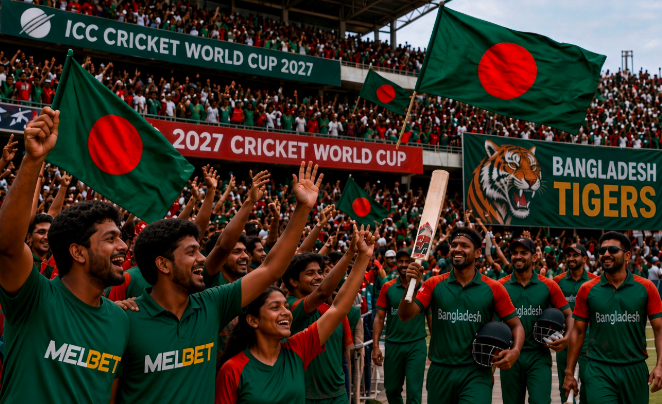
Cricket in Bangladesh has long transcended the boundaries of a mere sport. It is a national passion, an exhilarating thrill, and a religion that unites more than 170 million hearts. Every match played by the national team generates incredible excitement, and in the run-up to major tournaments, the entire country literally holds its breath in anticipation of a historic triumph.
The main question on the minds of analysts and millions of fans from Dhaka to Chittagong today is: Will Bangladesh achieve its long-awaited breakthrough at the ICC Men’s ODI Cricket World Cup in 2027?
The tournament, which will take place in October–November 2027 on fields in South Africa, Zimbabwe, and Namibia, promises to be a landmark event. For The Tigers, this is not just another world championship, but a true moment of truth, where a generation of experienced leaders and daring young talents must prove their ability to compete with the world’s elite.
New Era in Cricket: Bangladesh’s Road to WC2027 and the New Format
Bangladesh’s Road to WC2027: Current Standing in the ICC ODI Rankings
Unlike previous cycles, where every point was hard-fought amid mathematical uncertainties in the standings, Bangladesh has shown enviable consistency in the run-up to the 2027 Cricket World Cup. The Tigers are firmly holding their positions in the top tier of the ICC ODI rankings, which guarantee automatic direct qualification for the quadrennial main tournament. Ranking alongside the world’s leading national teams and the tournament hosts, South Africa and Zimbabwe, the Bangladesh team has spared its fans the nerve-wracking ordeal of the qualifying rounds.
Breaking Down the Reform: How the New WC2027 Format Works
The International Cricket Council (ICC) has officially restored the tournament’s scale by expanding the number of participating teams to 14. However, the main change lies in the structure, which differs radically from previous editions and requires a detailed explanation.
WC2027 tournament structure:
- Round 1 (Super Series): A preliminary tournament featuring the three lowest-ranked teams (seeds 12, 13, and 14). They play each other once; only the top team advances, while the other two are eliminated from the competition.
- Round 2 (Group Stage): The 12 teams (11 direct qualifiers plus the Super Series winner) are split into two groups of six. Based on the group-stage results, the top three teams from each group advance, as well as the best fourth-place team from both groups (wild card).
- Round 3 (Super 7 Elite Stage): The seven strongest squads in the world form a single group and play a single round-robin, with each team facing every other team once.
- Final Stage (Playoff): The top four teams from the Super 7 stage advance to the traditional semifinals (1st vs 4th, 2nd vs 3rd) and the final.
A Fresh Start for Bangladesh: Learning from Past Mistakes
Bangladesh views this tournament as a fresh start. The team’s recent white-ball performances have left a mixed impression. Many sports analysts are still breaking down the ICC Men’s T20 World Cup 2026: the most controversial year in the tournament’s history in detail, as The Tigers failed to perform at their best amid organizational disputes. However, inconsistent results in short-format cricket have forced the coaching staff to rethink their strategy. The 2027 campaign in the classic 50-over format (ODI) presents a new major opportunity to prove they are ready to play a long, tactically measured game.
The Bangladesh Cricket Team Foundation: Strengths and the Architecture of Success
A Triumphant Run and Maturity in Test Matches
The current resurgence of the Bangladesh cricket team is based on a significant leap in quality. Recent results in home ODI series have proven that the team is capable of overwhelming any opponent on its home turf. Progress in the most demanding format, Test matches, has been a key psychological factor. Victories in series and landmark matches at this level have toughened the players’ character and taught them patience and strategic thinking, qualities that are critical for success in the 50-over WC matches.
Bangladesh Cricket Team Players: A Golden Blend of Leaders and Young Talent
Today’s Bangladesh team strikes the perfect balance between vast experience and a youth hungry for victory. The team has a well-established core of world-class players:
- Litton Das: a technically skilled and elegant batsman capable of setting the pace early in an inning.
- Najmul Hossain Shanto: the captain and tactical leader who stabilizes the team’s performance in challenging moments.
- Mehidy Hasan Miraz: an elite all-rounder whose versatility gives the coaching staff incredible tactical flexibility.
- Taskin Ahmed and Mustafizur Rahman: an experienced bowling duo with a unique arsenal of cutters and powerful deliveries capable of dismantling opponents’ top batting lineups.
Alongside them, a new generation of fast bowlers is rapidly emerging, led by the lightning-fast Nahid Rana, as well as aggressive batsmen like Towhid Hridoy and Tanzid Hasan, adding depth to the team that was sorely lacking during protracted tournaments.
Internal Evolution: from Pitches to Systematic Professionalism
Success didn’t come out of nowhere. The key factors behind the team’s remarkable progress were:
- Variety in the spinners’ play: The spin department no longer relies solely on keeping the score in check but actively seeks wickets on all types of pitches.
- The resilience of the middle order: Middle-order batters have learned to rebuild innings after early losses.
- Home dominance and mindset: The ability to make the most of home conditions has translated into an overall increase in professionalism.
The modernized domestic competition system plays a huge role in this. Tournaments such as the National Cricket League and the Dhaka Premier Division Cricket League (featuring leading clubs such as Abahani Limited and Mohammedan Sporting Club), as well as systematic training programs for elite players launched by the Bangladesh Cricket Board (BCB), have begun to regularly supply the national team with athletes who are already accustomed to high international standards and the psychological pressure of competition.
Bangladesh’s Challenges on the Road to WC2027: Where Are the Pitfalls?
Foreign Fields Syndrome and Africa’s Fast Pitches
Despite obvious progress, Bangladesh’s main challenge remains its chronic inconsistency in away matches against top opponents. South Africa’s firm, fast pitches with high bounce are radically different from the slow, spinning tracks in Dhaka. Without quickly adapting to conditions at legendary stadiums like Wanderers Stadium in Johannesburg or Centurion Park, where the ball flies toward the wicket at breakneck speed, the top of the batting order could risk a rapid collapse.
The Problem with Final Overs and Power Hitting
Modern ODI cricket requires aggressive run-scoring. Bangladesh still struggles with power-hitting – the ability to hit boundaries with powerful shots. This is especially critical in the final stages of an innings (the death overs). If the middle and lower-order batters are unable to pick up the pace in the final 10 overs, the team risks falling short by 30-40 runs, which often proves decisive in matches against the giants.
Critical areas to be addressed by 2027:
- Batting. The team needs to adapt to the high bounce and fast pace of the pitches in South Africa and Namibia.
- Tactics. Improve run-scoring efficiency in the death overs (the last 10 overs of an innings).
- Physical condition. Proper rotation of pace bowlers to avoid serious injuries.
- Mentality. Developing mental resilience during the grueling Super 7 marathon.
Endurance of Pace Bowlers and the Super 7 Marathon
The revamped tournament’s length places heightened demands on physical fitness. Fast bowlers will face a tremendous workload in the hot African climate. Without adequate depth on the roster and smart rotation, the leaders of the bowling attack risk going into the decisive matches exhausted or injured.
Furthermore, the transition to the Super 7 stage is not just a short sprint, but a true psychological and physical marathon, where every match is played at the absolute limit of the players’ abilities, and the margin for error is minimized due to the rigorous playoff system. The coaching staff will have to strike a perfect, delicate balance between the invaluable experience of the veterans and the explosive, though sometimes erratic, energy of the young players. Furthermore, it is crucial that no internal conflicts or misunderstandings arise within the team, as these could trigger internal complaints from dissatisfied players or staff regarding training conditions.
Bangladesh at WC2027: Milestones and Future Horizons
What Would Be a Historic Success for Bangladesh?
For the current generation of The Tigers, realistic goals are clearly defined. The top priority is to confidently advance from the group stage to the elite seven. Qualifying for the Super 7 round will already cement Bangladesh’s status as a top team. However, the true, historic breakthrough that the entire nation dreams of would be reaching the semifinals for the first time ever. That milestone will forever change the world’s perception of Bangladeshi cricket.
Training Roadmap
The team’s level of readiness will be shaped over the next two years. The national side faces a series of important bilateral series and intensive training periods. Key factors for success along the way will include:
- Maintaining a stable lineup: minimizing chaotic changes to the squad.
- Managing physical condition: monitoring the workload of key players.
- Mental resilience: fostering a winning mentality that allows players to hold their ground in high-pressure, late-game situations.
Looking at the bigger picture, the future of Bangladeshi cricket looks promising. Even after the 2027 cycle concludes, the country has a solid foundation. Continued, systematic investment in youth programs and U-23 national teams will ensure the influx of new talent doesn’t dry up, allowing the senior national team to remain highly competitive on the world stage for years after the African tournament. For convenience, many fans use the MelBet mobi app to quickly get real-time updates on the preparations of reserve squads and youth leagues.
Cricket Fans, Analytics, and the Digital Age
Modern fan culture has long gone beyond simply cheering in front of TV screens. Today’s cricket fans are in-depth analysts who break down every innings, study bowler and batter statistics, and analyze pitch and weather conditions in real time. For a detailed look at the reliability of gaming platforms, fans should check out the latest MelBet review, which describes in detail convenient ways to combine sports analytics with interactive entertainment.
In this context, modern digital platforms have become a natural part of sports life, and fans often activate a special MelBet promo code during major matches to access extra analytical features or welcome bonuses. Also, during breaks between drawn-out overs, fans actively try out cricket slots, which help maintain a dynamic thrill throughout the long tournament day.
Cautious Optimism: Bangladesh’s Chances at WC2027
An analysis of the Bangladesh national team’s potential ahead of the WC2027 shows that the team is in perhaps the best position it has ever been in. The Tigers have a well-coordinated squad, a robust training infrastructure, and leaders at their peak. They have proven that they are capable of beating anyone when all elements of their game work together as a single, well-oiled machine.
However, reality dictates its own terms. African pitches and the new, uncompromising Super 7 format will be a grueling test of maturity. Bangladesh has the potential to rewrite history in 2027, but this breakthrough won’t come easily: they’ll have to fight for it in every over, showing maximum concentration and strict discipline. The cricket world is holding its breath, awaiting this major Bengali test.